Tuesday, April 6, 2010

Five workers found dead in China mine collapse

Five trapped workers were found dead Tuesday in northern China more than a week after their coal mine was flooded by a rush of underground water, state media reported.
The fatalities came a day after 115 miners were pulled out alive amid cheers, as rescuers scrambled to reach dozens more believed to be still trapped inside.
The miners were part of a larger group of 261 working in the Wangjialing mine when it flooded on March 28. Rescuers were able to reach 108 miners immediately after the flooding.
Before the Monday rescue, the miners tapped and shouted to indicate they were alive, state-run Xinhua news agency said. Hundreds of rescuers were working around-the-clock to drain water, monitor gas and pull out miners, said Wang Jun, governor of
Shanxi province, where the mine is situated

Mine accidents are common in China. In 2009, 2,631 people were killed in such accidents. The figure, while high, is down from 2002 when 6,995 people died.
On Monday, the country launched a two-month campaign of safety inspections in mines and other industries that have had serious accidents.

U.S. seeks $16.4 million fine against Toyota

The Department of Transportation's National Highway Traffic Safety Administration is seeking the maximum fine of $16.4 million against Toyota Motor Corp. for failing to notify the agency of a "sticky pedal" defect in its cars for at least four months.
Under federal regulations, automakers are required to inform the agency within five days of determining that a safety defect exists in one of its products.

NHTSA learned, through documents obtained from Toyota (TM), that the automaker knew of sticky gas pedal problems since at least September, 2009, the agency said in an press release.
"We now have proof that Toyota failed to live up to its legal obligations," said Transportation Secretary Ray LaHood. "Worse yet, they knowingly hid a dangerous defect for months from U.S. officials and did not take action to protect millions of drivers and their families. For those reasons, we are seeking the maximum penalty possible under current laws."
NHTSA is still investigating to see if Toyota committed any additional violations that may warrant more penalties, the agency said. Under federal regulations, $16.4 million is the most an automaker can be fined for a single violation.
Toyota said it has not received a letter from the NHTSA about the fine, but responded to the announcement by saying the company has begun to address the agency's concerns.
"We have already taken a number of important steps to improve our communications with regulators and customers on safety-related matters as part of our strengthened overall commitment to quality assurance," the company said in a statement. "These include the appointment of a new Chief Quality Officer for North America and a greater role for the region in making safety-related decisions."
GM to expand use of brake override system
Toyota cars and trucks have been the subject of at least three separate major recalls in the past year. One was for the "sticky pedal" situation in which gas pedals, as they age, begin to stick in a partially depressed position. Another was for gas pedals that can stick on some floor mats and a third was for braking problems on Toyota Prius hybrid cars.
The biggest fine that's ever been levied was just $1 million taken from General Motors in 2004 for failing to deal promptly with a windshield wiper issue, an amount that was negotiated down from the $3 million NHTSA originally asked for.
Toyota could challenge the penalty and question how the NHTSA determined the record amount, especially since the difference between Toyota's and GM's fines is so large, said senior analyst Jessica Caldwell of automotive Web site Edmunds.com.
"It'll be interesting to see how Toyota responds," she said. "But $16.4 million is a drop in the bucket of cash Toyota has, so they might just find it easier to pay and avoid a bigger news story."
It also strikes experts as odd that regulators would seek the maximum penalty in a case in which the specific defect involved resulted in no serious crashes, injuries or deaths. "I see this as politically motivated," said Ed Higgins, a Michigan attorney who has worked with automakers in defect cases. "NHTSA is under a lot of political pressure to get tough."
In documents filed with NHTSA, Toyota has indicated that it did not originally believe the sticky gas pedals were a genuine safety issue. At worst the pedals got stuck only an inch or so down resulting in a situation the driver could easily control using the brakes.
That belief gives Toyota a ready defense, Higgins said. The regulations state that the automaker has five days from the time it determines a safety-related defect exists to report it. If Toyota didn't see this as safety related, Higgins said, the clock wasn't running.
There were injuries and deaths alleged to result from a separate issue in which gas pedals could become stuck on floor mats. NHTSA has not announced a fine in that recall.

Woods says he's better person after rehab

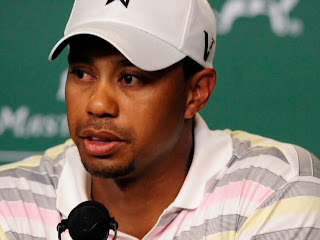
A humbled Tiger Woods returned Monday to Augusta National Golf Club and told reporters that he has emerged from rehab a better man, if not a better golfer.
"I'm trying as hard as I possibly can each and every day to get my life better and better and stronger, and if I win championships along the way, so be it," said the four-time winner of the Masters, which tees off at Augusta National on Thursday.
Woods' 35-minute news conference came more than four months after he crashed his Cadillac Escalade into a fire hydrant and a tree outside his family's home in a suburb of Orlando, Florida.
The November 27 incident, which left him with a sore neck and a cut on his lip that required five stitches, also set in motion the crash of his storybook life.

A few days beforehand, the National Enquirer had reported he was having an affair with a New York nightclub hostess, who denied it. But that allegation was followed by others, and Woods' tightly controlled world and image soon began to crumble, threatening his five-year marriage to former model Elin Nordegren.
Just after Christmas, he entered a rehabilitation center, where he stayed for 45 days.
"It was to take a hard look at myself, and I did, and I've come out better," he said.
In February, Woods said he had been in therapy for issues, which he did not explain, and he acknowledged multiple extramarital affairs.
He was no more forthcoming on Monday. Asked what the rehab was for, he said, "That's personal, thank you."
Blog: Coverage of the Woods briefing
During his treatment, he said, he missed the first birthday of one of his two children. "That hurt a lot," he said, adding he has vowed never to miss another one.
Woods said he is continuing with treatment, has returned to meditating "religiously" and feels "more centered, more balanced."
He said that, although he has won numerous tournaments in the past few years, he had not been having as much fun as he used to. "When you live a life where you're lying all the time, life is not fun," he said. "Now that's been stripped away, and here I am. It feels fun again."
The 34-year-old golfer indicated that he hopes to woo back sponsors, who have left him in droves.
"Do I understand why they dropped me? Of course," he said. "I've made a lot of mistakes in my life, and I totally understand why they would do that."
He added: "Hopefully, I can prove to the other companies going forward that I am a worthy investment, that I can help their company, help their company grow and represent them well. I felt like I was representing companies well in the past, but then again I wasn't doing it the right way because of what I was engaged in."
But Woods appeared gratified that he remains popular among the golf fans who showed up at Augusta National on Monday morning.
"For them to still cheer for me is just incredible, it really is," he said about the galleries' reaction to his play in a practice round.
Woods started the round at the famed course at 8 a.m., dressed in a striped shirt and dark slacks and flashing an occasional smile.
He promised to show more appreciation for his fans. His failure to have done so in recent years, he said, "was wrong of me."
"Too many kids have looked up to me and so many families have supported me over the past few years. I just want to say 'thank you' to them," he said.
He said that his wife will not attend the Masters. He did not answer a reporter's question about whether this was a sign that she wasn't ready to support him.
Woods apologized to other players, whom he said the news media have "bombarded" with questions about him. "I certainly apologize to all of them for having to endure what they've had to endure over the past few months," he said.
Woods said he will try to play more calmly. "I made a conscious decision to try and tone down my negative outbursts," he said. "Be more respectful of the game."
Woods denied ever having taken any illegal drugs, but said he had received injections of platelet-enriched plasma to help speed the healing of his left knee after he blew out the anterior cruciate ligament in 2008 and subsequently tore his Achilles heel in his right leg.
He said he also underwent treatment in a hyperbaric oxygen chamber to speed the healing process.
Woods also acknowledged having taken Vicodin to help relieve pain and the sedative Ambien to help him sleep when he was concerned about the failing health of his father, Earl, who died in 2006. But he said he had never taken any illegal drugs.
Asked whether Ambien may have played a role in his car wreck, for which he was cited for careless driving, the golfer did not respond directly. "The police investigated the accident and they cited me 166 bucks and it's a closed case," he said.
Woods was unsparing in his self-criticism. "I was rationalizing; I was denying, in total denial, at all times," he said. "I lied to myself; I lied to others."
He added: "The way I was thinking caused so much harm with the people that I loved and cared about the most on this planet."
Woods said he learned during his stint in rehab that he had fooled himself in addition to fooling others. "I take full responsibility for all I have done, and I don't take that lightly," he said.
Asked whether his reckless behavior indicated that he wanted to get caught, Woods said, "I don't know."
"All I know is I acted just terribly poorly, made just incredibly bad decisions and decisions that have hurt so many people close to me. That's enough," he said.
Though Woods projected the image of a changed man, he said his desire to win remains immutable. "Nothing has changed," he said. "I'm going to try and go out there and win this thing."
Though he had delivered a carefully managed statement in February to a small, hand-picked crowd, and given two one-on-one interviews, Monday's news conference was his first in months.
"The mental challenge that is facing Tiger Woods as he returns to Augusta National and then afterwards at other PGA Tour events, we can assume, later on in the 2010 season, is probably something that no other golfer has ever faced before," said David Dusek, deputy editor of Golf.com.
However, Woods' choosing to return to the Masters may be a strategic move as the organizers of the tournament traditionally have kept a tight rein on the media and spectators. Woods, a four-time Masters champion, can expect to be shielded and protected to a certain degree.
"This makes sense," said Chris Verdery, a golf pro at the River Golf Club in the adjacent town of North Augusta, South Carolina. "People really love him here in Augusta. He's been wonderful for the Masters, the city of Augusta, and everybody is excited to have him back."
Woods hopes to claim his 15th victory in a major tournament at the Masters.
His caddie, Steve Williams, has said Woods would not be returning to the game unless he felt he could win. Some leading bookmakers have him as the favorite to prevail.
But Dusek said, "I think it is a little bit much to sort of assume that he is just simply going to walk on, after really not having any competitive play for the better part of four months, walk into the season and be able to physically dominate the way that we assume Tiger Woods always does.
"I would look for him to improve and get better as the season goes on. I would not be surprised if he wins golf tournaments in 2010, but I do not think he can come out and win the Masters right away."
And the focus -- at least for the media -- will be on the spectacle rather than the sport.
"TMZ, Entertainment Weekly and People magazine, along with 'Extra,' are ... typical calls I don't get, come Masters week," said Augusta Mayor Deke Copenhaver.
Still, Woods' devoted fans are looking forward to seeing him play once more.
"I love his golf, and that's what we're here for, that's what I like to see, and I really don't care about his personal life," Masters ticket holder Dick Benck said.

U.S. to announce new nuclear weapons strategy

The United States will swear off the development of new generations of nuclear weapons and reduce its reliance on them in a sweeping overhaul of its nuclear strategy due out Tuesday.
The Obama administration's Nuclear Posture Review will alter decades of U.S. policy to provide an incentive for countries to stay within the rules of the 1968 Non-Proliferation Treaty, a senior administration official told CNN. The focus of U.S. nuclear policy will be on isolating countries that are flouting their obligations under that pact, the official said.
President Barack Obama is scheduled to announce the new strategy on Tuesday, two days before he plans to sign a new nuclear arms treaty with Russia that reduces both countries' missile stockpiles. The president is expected to be joined by several Cabinet members, including Defense Secretary Robert Gates, Secretary of State Hillary Clinton and Energy Secretary Steven Chu.
Under the new strategy, preventing the spread of nuclear weapons and their use by terrorists becomes the top priority of the U.S. nuclear agenda. And the United States will make "substantial investments" in managing its current weapons rather than build new ones, said the senior administration official, who did not want to go on record ahead of Tuesday's announcement.

"It will also extend the life of warheads currently in the nuclear arsenal," the official said. "This is an alternative to developing new nuclear weapons, which we reject."
That policy is aimed at encouraging further cuts in world stockpiles and stem the proliferation of atomic bombs, the official said.
In 2009, the Bulletin of Atomic Scientists estimated the current U.S. nuclear stockpile at 5,200 nuclear bombs, including 2,200 operational, long-range strategic weapons.
Seven other nations -- Britain, France, Russia, China, India, Pakistan and North Korea -- are declared nuclear powers. Israel is widely believed to have developed nuclear weapons, but has never declared that publicly.
Obama has made reducing the global nuclear threat a top priority of his presidency, and will host a summit on reducing the global nuclear threat later this month. The purpose of the new strategy is to prevent nuclear terrorism and proliferation while maintaining an effective nuclear deterrent for the United States and its allies "for as long as nuclear weapons exist," according to the senior administration official.
Continued investment in the nuclear weapons system will enable the simultaneous reduction in overall warheads and increase in strategic effectiveness, the official said.

Thursday, February 11, 2010

Review of forex education

Just wanted to say thanks for another great call on the EUR/USD and USD/JPY. The Jimmy's bands signal at around 10:15am EST was beautiful. 75 pts. in an hour and still have part of my trade running, plus picked up 35 buying USD on a limit order earlier. Thanks again for all the work you guys put in to make this the best educational service out there. It's truly a 5 star education. I look forward to a huge 2010.
Firstly I just want to say thank you for putting together the best Forex education material I have come across in my 5 unsuccessful years of currency trading. In my 5 years I have blown out many accounts and have spent tens of thousands of dollars on everything from 'black box mechanical systems to Forex mentors and educators all of which over promised and certainly under delivered. However I love this business so much I am determined no matter what the cost to be successful, I just wish I had found your course years ago. You really are the only educator/mentor I have ever come across that is actually dedicated to helping his students succeed at currency trading. So again thank you Jimmy!
You guys made me pretty rich in the last two days! You don't even wanna know how much money I made: it is ridiculous. I know this is only a week I have been trading with you guys, but I am an experienced trader and I can clearly see, for someone who knows what they are doing, you guys are the best there is out there."
I have been in this market for about a year. I lost a considerable part of my trading account due to the lack of any meaningful education and my own carelessness. I learned little about good strategy and even less (nothing) about good risk management. I'm glad to be here with you and I believe that I've FINALLY found a trustworthy and skillful source of trader training. THANKS AGAIN.
A year ago I was losing money and frustrated. Now I'm making over 300 pips a month consistently and am starting to increase my lot size. Thank you for all of your help.
I want to thank you for the awesome job you are doing with this program. I've been involved in currency trading for some two years now and have gone through the mill. I can say that finally thanks to this instruction I am becomming a real trader on my own .. not a losing gambler...and at last I am profitable !! I've really enjoyed these last few weeks'of the daily Review Previews and the new strategies.
I have had 2 years with Jimmy. His understanding of the market and his ability to teach about the issues and interpretation of what you see from a professionals perspective is second to none. While he has many approaches that he draws from its his overall approach that has kept me an avid member for so long.
Based on my own personal comparison of several forex educators today, Jimmy wins hands down. His mentorship is concise, precise and after six months of study you will have the knowledge to trade like a pro. Needless to say, mentorship will pay for itself very quickly.
Jimmy Young's experience as a trader and the knowledge that he shares with his members is the most comprehensive of any services available. Jimmy Young is brutally honest about trading and is genuinely interested in teaching you how to become a trader. I learned more about trading forex in the first 3 months with Jimmy than I did with any other service.
I had been trading Forex for 4+ years when I came across Jimmy's site. I signed up and must say I was impressed with the Daily Reviews and fundamentals. Jimmy is not only trying to teach you a system, but is trying to show you how to "think" like a trader as well. I am definitely impressed.
Jimmy's course really helped me understand the fundamentals of trading. This is sadly missing with a lot of courses out there. His emphasis on knowing if an individual currency is trending as apposed to a pair has helped a lot. The longer video presentations are extremely informative.
Most weathered traders that I know and I keep in touch with, have at some point in time taken Jimmy's courses and or subscribe to Jimmy's Review / Previews... Jimmy explains most important factors, his experience is next to none, his abilty to pass on his knowledge is simply amazing, I purchased Jimmy's subscription more than a year ago and would reccomend to all those new and experienced traders out there that want to make it in this business.
When it comes to FX, Jimmy knows what he's talking about . He teaches you how to trade the Forex like a Pro, his strategies are unique. He's approachable--answers direct questions himself, and the member's area is awesome. Plenty of detailed videos and presentations. The customer's service is fantastic too. Definitely, a must-do to any serious forex trader/apprentice who wants to properly learn how to trade the Forex market.

Tuesday, February 9, 2010

Death of Nancy Kerrigan's father ruled a homicide

The medical examiner has ruled that the death of Daniel Kerrigan, the father of figure skater Nancy Kerrigan, was a homicide, the Middlesex County district attorney's office said Tuesday.
The skater's brother, Mark, was arraigned in January on assault and battery charges in an incident involving his father, but the district attorney's office would not say if other charges might be filed against the younger Kerrigan in light of the medical examiner's finding.
Daniel Kerrigan, 70, died January 24 after an alleged altercation with his son at the Kerrigan home in Stoneham, Massachusetts.
The Kerrigan family released a statement through their attorney expressing disappointment "that the medical examiner would release a cause of death without having all of the relevant facts. We believe this finding to be premature and inaccurate."
"The Kerrigan family does not blame anyone for the unfortunate death of Dan Kerrigan, who had a pre-existing heart condition," said the family statement, released by attorney Tracy Miner.
Mark Kerrigan, 45, pleaded not guilty to the charges against him January 26. Through his attorney, he denied any responsibility in his father's death.
According to Middlesex County Assistant District Attorney Elizabeth Keeley, police responded to a 911 call at approximately 1:30 a.m. January 24 from Brenda Kerrigan, wife of Daniel and mother to Mark and Nancy Kerrigan.
Keeley told District Court Judge Mark Sullivan during the arraignment for Mark Kerrigan that there was a violent argument and struggle between the father and his son, resulting in the elder Kerrigan falling or collapsing on the kitchen floor. Keeley said Mark Kerrigan told authorities "that he did in fact have an argument with his father, the argument became physical, he grabbed his father around the neck, and at some point the father collapsed to the floor."
According to Keeley, police found Mark Kerrigan in the basement of the house, "clearly intoxicated" and "extremely combative." He refused to comply with police officers, said Keeley, and they had to subdue him with pepper spray before forcibly removing him from the home.
Mark Kerrigan's attorney, Denise Moore, said in court that Kerrigan was unemployed, was recently released from a correctional facility and was living at home with his parents. He is taking medications and seeking psychological help for post-traumatic stress, apparently from his time in the Army, she added.
Despite appeals from his attorney, the judge ordered Kerrigan held on $10,000 cash bail. His next court appearance is expected to be February 24.
Nancy Kerrigan first gained prominence by winning a bronze medal at the 1992 Winter Olympics in Albertville, France. In 1994 she earned a silver medal in Lillehammer, Norway. But she is perhaps best remembered for being injured in an attack before the 1994 Winter Games by skating rival Tonya Harding's ex-husband and an accomplice.

Murtha's gallbladder procedure rarely deadly

Taking out a patient's gallbladder is routine. At least 500,000 such surgeries are done each year in the United States. It takes an hour or two, and the patient can go home that day or the next.
But in rare cases, the
surgery can be deadly. Democratic Rep. John Murtha of Pennsylvania recently died after complications from the procedure after doctors "hit his intestines" during surgery, a source close to the late congressman told CNN.
Murtha underwent the scheduled laparoscopic surgery at the
National Naval Medical Center in Bethesda, Maryland, on January 28, to remove his gallbladder, and was discharged. Three days later, he was admitted to Virginia Hospital Center's Intensive Care Unit because of major complications from surgery, the hospital said in a statement. He died there Monday at age 77.
The National Naval Medical Center declined to reveal additional details on Murtha's death.
At most, only one out of every 1,000 patients, dies during gallbladder removal, according to the American College of Surgeons. Factors that increase the risk of death include gangrene, a burst gallbladder, or severe diseases.
The laparoscopic surgery is a safe, minimally invasive procedure, said Dr. L.D. Britt, president-elect of the American College of Surgeons and professor at Eastern Virginia Medical School. Out of hundreds of thousands of cases, only a handful result in damage to the intestines, he said. Precise statistics are not available.
"Even when you have an injury, it doesn't often, obviously, lead to death," Britt said. "This is very surprising, but we know that death is a possible complication of any procedure."

The gallbladder, a small pear-shaped organ under the liver, squeezes bile from the liver out into the small intestine. Signs that this organ may need to be removed include sharp pain in the right abdomen, low fever, and nausea and bloating.
In a laparoscopic cholecystectomy, the technical term for the procedure, the surgeon removes the gallbladder with instruments placed into four small slits in the abdomen, according to the American College of Surgeons. This kind of surgery is performed to remove
gallstones or to remove an infected or inflamed gallbladder.
A laparoscope, a telescope-like instrument with a light and video camera on the end, helps the surgeon see inside the abdomen. Removal of the gallbladder this way usually takes one to two hours. This is much more common and less invasive than an open cholecystectomy, which involves making a six-inch incision in the abdomen and cutting through to the gallbladder.
Injury to the intestines during the procedure is rare, but it is a risk that patients are informed about before surgery, said Dr. Albert Wu, professor of health policy and management at the Johns Hopkins Bloomberg School of Public Health.
If the intestine is perforated, stool can leak into the abdomen, causing a systemic infection called sepsis, he said. If the patient begins taking antibiotics immediately when that happens, that could solve the problem, but if the perforation goes unnoticed and several days pass, the infection can get worse and result in death, Wu said.
This is just one possible scenario, however, experts said. It is unknown at what point during the procedure his intestine may have been harmed, or in what way.
"It certainly is a surgical error, I just don't know where the mistake [was], how that occurred," Britt said.
The damage could have occurred during dissection or, alternatively, when inserting the trocar, a surgical device that aids the introduction of other instruments into the abdomen, Britt said. Another possibility is that the heat probe could have injured the intestine, and later the area that got burned could have opened up and leaked, Britt said.
The takeaway message is to always call your doctor or come back in the hospital if you feel unwell after surgery, experts say.
"If you suspect that something is wrong, without delay you should contact the surgeon because time really is of the essence," Wu said.
A 2009 study led by the Mayo Clinic found that almost 9 percent of U.S. surgeons who responded to the survey said they had made a major error in the previous three months.
"No operation is 100 percent free of complications and problems," Britt said. "The best you can do is, obviously, follow instructions, as I'm sure [Murtha] did."
Britt stressed that the laparoscopic procedure is common. He performed three last week, two that went smoothly and one of which needed to be converted into an open procedure because of scar tissue. The public should not be frightened, he said.
"At the end of the day, if you don't have it done and you have a diseased gallbladder, you're talking about a very high complication rate and a possibility of death," he said.